Devin Max: A Full Review After Two Weeks of Heavy Useديفن ماكس: مراجعة كاملة بعد أسبوعين من الاستخدام المكثف
After two weeks of heavy use, I can finally give Devin a full review and tell you exactly where I stand on the subscription.
I was on Devin Max, the $200/month plan.
This review is not paid and not sponsored. It is my honest opinion from my own use, the way I always do it. I will cover the good and the bad, with nothing held back.
Let me start with the part most of you are waiting for: usage limits.
Before you pay for any subscription, you ask yourself one question. Will this actually last me the week? Will the allowance stay with me until the next reset, or will it burn out in two or three days and leave me stuck, paying for more usage or falling back on another subscription?
With Devin, the answer is yes.
At one point I had more than 17 Sol Max agents running at the same time on a huge task built on 500,000 words of material, and it burned only 4% of my usage. You know how much Sol thinks and works, especially on Max effort, so that number surprised me completely.
Fable surprised me even more. Devin is the only subscription where using Fable actually feels reasonable. Everywhere else, outside Claude’s own subscription, you are paying for those tokens directly. Here it feels subsidized. I ran Fable on a task that took around half an hour and my usage went up by 1%.
So we are talking about real working conditions where you can use models like Fable and Sol for planning, drop to lower effort or a cheaper model for execution, then come back to the expensive model when you actually need it. That is practical, because the models here do not burn your account in an insane way.
The pricing is another highlight. I will mention numbers, but I do not want you to focus on them, because I do not know when you will read this review and I want it to stay useful for a long time. As I write this, Sol is available at around $6 per million tokens inside Devin. That is Sol at the price of open models, and open models were supposed to be the cheap alternative.
You also get genuinely strong models for free. Right now GLM is free, and their own SWE model is free too, and it is very good.
Since we are on SWE, their model deserves its own line. It is a lot like Composer in Cursor. you can lean on it, and you get good results out of it, especially since it is built on Kimi K2.7 Code.
Put all of that together, free models plus excellent pricing plus a generous subsidized allowance, and you finish the week comfortably. I have reached the point where almost every $200 subscription feels like it runs out in two or three days. Devin is the exception, and it is a big exception. You can work on it, use it heavily, get a lot done, and sometimes feel you are getting far more than you pay for.
I hope they keep this the way it is, because it is a real competitive advantage and it matters to most people.
Caching matters at this scale, so I watched it closely.
Across roughly a billion tokens of real work, the share of tokens served from cache reached about 95%, which is excellent. In my experience a lot of harnesses come in well below that.
One task looked like this:
20 million input tokens 3 million output tokens 422 million cached tokens 445 million tokens in total
That is 94.8% of the total volume cached.
Devin is not the highest I have seen. There are harnesses that reach 98% and 99%. But around 95%, inside a subscription that hands you this mix of subsidized models, gives you a very comfortable margin. When you are working with massive contexts and thousands of agent messages, weak caching eats your allowance fast.
The harness is the real reason I recommend Devin
Usage limits are not what makes me recommend Devin. The bigger point is that Devin as a harness, as an environment, improves what the models give you.
Take Sol. In Codex, at lower effort, it gets lazier and somehow turns into a chat model. At higher effort it suffers badly from overengineering, exaggerating and doing things you never asked for.
In Devin this never happened at all.
I do not know exactly what they did, but I tested Sol at every level and it genuinely gives you the GPT-5.5 feeling in discipline and instruction following. It gets you to the result without dragging you into detours, without becoming a burden, and without needing constant supervision. I found the same thing with every model I tried.
Still, an opinion is just an opinion, so I tested it properly. I built a complex task of about 300,000 words in multiple languages, the kind that demands intelligence, breadth, comprehension and long stamina from the agent, and I ran it in Claude Code, Zcode, Codex and Devin.
The result was striking. Devin always had the fewest errors. This was not a one-off. I repeated it more than once, on different databases, on tasks of that size, and it was consistently the lowest in errors and the one needing the fewest final corrections and finishing touches. It holds context impressively well.
There is another pattern worth mentioning. In Claude Code, Codex and Zcode, models below the Sol and Fable tier usually need a goal mode to keep going to the end. Devin does not have a goal mode, and I wish it did. Even so, the same models that stall elsewhere finish the task in Devin. That one impressed me.
Overall, by my own measurements, instruction following and output quality improved by around 22% compared to the other harnesses. That is a big difference, and it is real and noticeable.
It just does the work
I gave one task to Claude and Codex as well. Claude got busy asking itself whether it could legally carry out parts of the task and kept stopping, when there was nothing illegal in it. Codex dropped part of what I asked for and started building a whole section I never requested. Devin executed the task directly and with far more discipline.
That is worth keeping in mind. Devin does not lose half the task in objections, does not reinvent the requirement from its own head, does not stop every other minute. It understands the context, reads its environment extremely well, and knows how to act inside it. It is independence mixed with discipline.
It also sticks to the rules I give it, strongly, and that is something I do not compromise on.
Devin Cloud
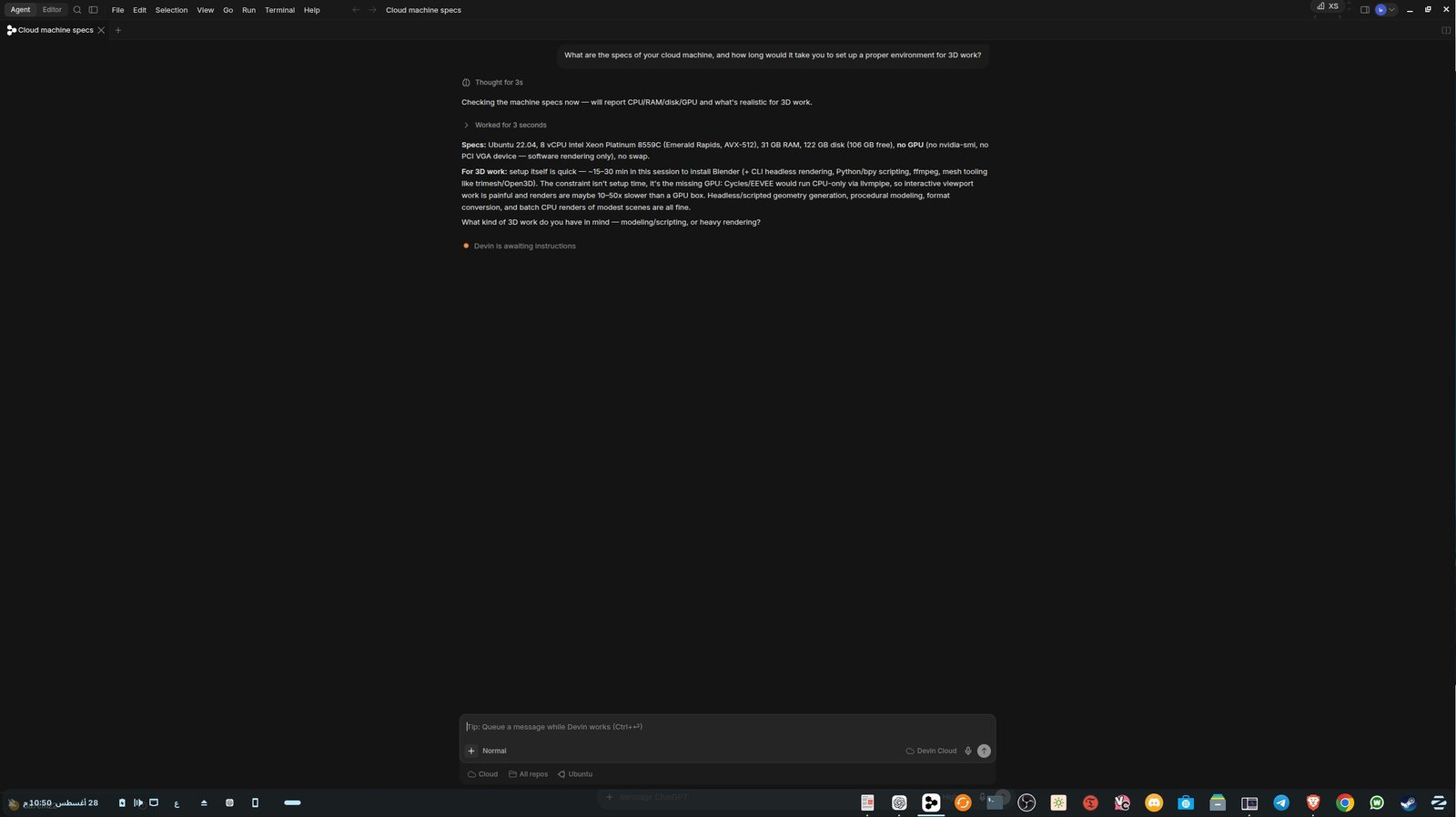
The cloud agent is one of the best features here. It is like Grok Bot in the sense that your agent has its own machine.
I use it constantly because my Mac has 24 GB of RAM, and launching a large number of agents locally alongside everything else usually chokes the machine and drags the performance down. With a cloud agent, it takes the whole task, works on its own machine on Linux or Windows, and comes back to me with the final result. My machine does not fill up with temporary files and random leftovers. I just receive the result.
The nice part is that you can have the agent use whatever Linux distribution you want. You can ask it for a specific distro, have it spin that up as a virtual machine, and it works normally and does the job there.
Other subscriptions usually do not offer this at all, and when they do it comes with a separate meter and a separate bill. Here it is simply part of the subscription you already have.
And because it lives in the cloud, you can log in from any device at any time and find your conversation and your work exactly where you left it. It is smooth.
Slack and automation
The way Devin works with Slack is excellent. You can automate tasks and have it talk to you like a developer and engineer sitting inside your own team. That part is better than it first looks.
Testing
Devin is one of the best harnesses I have used for running tests and making the whole testing process easier. The results come back accurate and clearly free of the randomness I get elsewhere.
That matters even more when several agents are running at once. If I have to verify everything manually after every agent, the value of running them in parallel disappears.
It is not limited to coding
Devin is not locked to programming. You can use it for programming, for creative work, for building websites, for writing, for anything you need without exception.
We all know there are harnesses that specialize in coding and get noticeably worse outside their lane. That is not the case here. Whatever kind of work you do, you will enjoy it.
A different view on a few things
Now for the other side. I would not call it negative. It is more that some people will experience a few things differently, and almost all of it sits in the desktop GUI, not in the agent.
I understand these decisions from their side, since this subscription is built first for advanced users and professional developers. Still, it would be great to have a choice between the current mode and a simpler one, with a lighter interface and an agent that talks to you more simply. That single move could win them a large market of vibe coders and people who want to enjoy working with an agent without all the engineering detail.
A few smaller things sit in the same area. On the Mac app, closing Settings sometimes drops me on the main screen instead of back in my conversation, and I have to open it again, which does not happen on Linux. Twice after an update the app misbehaved and I had to close it fully and reopen it, which felt like a passing thing rather than a permanent one, but I am mentioning it for transparency. I would also like to see my usage in the same interface I am working in, how much I used this week and what is left, without going into Settings. And I would rather the app give me everything itself instead of sending me to the browser every time I click into certain settings. Editing the agent instruction file from the GUI would help too, rather than opening files and editing them by hand.
On that last point, when I started with Devin it was reading a CLAUDE.md file, then I asked it to create and adopt its own file. In new conversations it sometimes leaned on the imported Claude instructions and sometimes on the file I told it to use. It is a small thing, but it creates some ambiguity.
Voice input is another small one. I was recording a long instruction with voice to text and it stopped by itself after a short while. I do not know if that is a bug or a limit, but I would love a ten-minute window so I can take my time explaining a task without being cut off in the middle.
The one I care most about is steering and subagents. When I send a steering message to the parent agent while subagents are running, that message sometimes cancels them. I tried it more than once and it happened again. I would rather be able to talk to the parent agent without disturbing the agents working underneath it. Related to that, if the parent opens five subagents and I do not like how it divided the work, it cannot stop them itself. Cancelling exists in the protocol but has to come from the user, so the parent can resume its agents but cannot stop or replace them.
And I still want a proper goal mode. Ironically Devin needs it less than other harnesses because its agents already keep going, but for long tasks I want to define an outcome and tell it not to stop until that outcome is reached.
The encouraging part is that all of this is about the desktop app. In the terminal your experience is clean. The CLI is fast, easy to control, very stable and genuinely enjoyable, and I find it among the best and most reliable out there. If you are subscribing to run Devin from the terminal, you will enjoy it a hundred percent with none of the above. If you prefer the GUI, there are a few trade-offs you may need to adapt to, and that comes down to taste. In my estimation most people will adapt to them easily, and experts certainly will.
The community and the team
I put serious effort into Devin for a reason, and to be honest with you, part of it is the community.
The Devin community is outstanding. People contribute constantly, creators share ideas and real experiences, and it feels genuine and far from marketing and noise. I am learning and improving from that community faster than I was before.
Their growth is impressive too, and they listen to people, to their experiences and their opinions. I am confident the notes I have raised here, and the notes other people raise, are read and taken seriously, because I watch their growth daily and I see how the team interacts with people and stays close to them. They make you feel like part of the system. When you want to feel that your voice and your problems are actually heard, Devin gives you that. Honestly, only two or three companies in this space give me that feeling. Devin is one of them.
Final thoughts
The most important thing I can tell you at the end of this review is that because of Devin I cancelled Claude and Codex, and my conscience is clear, because I trust it completely and I trust that Devin is enough. I think plenty of people will feel the same.
None of us wants four, five or six different subscriptions with separate monthly budgets. If one subscription covers most of it, solves most of the problems and gives me something excellent, then why not.
My advice is that Devin is worth trying. Try one month, take the Max plan, focus on it properly, and you will not lose anything. Give it real work, run several agents, try the models, use the cloud agents and the CLI. If it doesn’t give you what you’re looking for, then never take my word for it again.
But after two weeks of very heavy use, I know exactly where I stand. Devin Max is one of the very few $200 subscriptions where I feel I am getting more than I paid for.
بعد أسبوعين من الاستخدام المكثف، صار بوسعي أخيرًا أن أراجع ديفن مراجعة كاملة، وأن أقول لكم بوضوح أين أقف من الاشتراك فيه.
كنت مشتركًا في ديفن ماكس، وهي الباقة التي سعرها ٢٠٠ دولار في الشهر.
هذه المراجعة ليست مدفوعة الأجر، ولا برعاية أحد. إنما هي رأيي الصادق من استخدامي أنا، على عادتي. وسأذكر المحاسن والعيوب، ولن أخفي منها شيئًا.
وأبدأ بما ينتظره أكثركم: حدود الاستخدام.
قبل أن تدفع ثمن أي اشتراك، تسأل نفسك سؤالًا واحدًا: هل سيكفيني فعلًا طوال الأسبوع؟ هل تبقى الحصة معي حتى تتجدد، أم تنفد في يومين أو ثلاثة فأبقى عالقًا، إمّا أن أدفع ثمن استخدام إضافي، وإمّا أن ألجأ إلى اشتراك آخر؟
والجواب مع ديفن: نعم.
شغّلت مرةً أكثر من ١٧ وكيلًا من سول بأقصى جهد في وقت واحد، على مهمة ضخمة مادتها ٥٠٠ ألف كلمة، فلم تستهلك من حصتي إلا ٤٪. وأنتم تعرفون كثرة تفكير سول وطول عمله، ولا سيما بأقصى جهد، ولذلك فاجأني هذا الرقم كل المفاجأة.
وفاجأني فايبل أكثر من ذلك. فديفن الاشتراك الوحيد الذي تشعر فيه أن استخدام فايبل معقول فعلًا. أما في غيره، خارج اشتراك كلود نفسه، فأنت تدفع ثمن تلك الرموز مباشرة، وأما هنا فكأنها مدعومة. شغّلت فايبل على مهمة استغرقت نحو نصف ساعة، فلم يرتفع استهلاكي إلا ١٪.
فنحن إذن أمام ظروف عمل حقيقية: تستعمل نماذج مثل فايبل وسول في التخطيط، ثم تنزل إلى جهد أقل أو نموذج أرخص في التنفيذ، ثم تعود إلى النموذج الغالي حين تحتاج إليه فعلًا. وهذا عملي، لأن النماذج هنا لا تحرق حسابك حرقًا جنونيًا.
والأسعار ميزة بارزة أخرى. سأذكر أرقامًا، لكني لا أريدكم أن تقفوا عندها، لأني لا أعرف متى ستقرؤون هذه المراجعة، وأريدها أن تبقى نافعة زمنًا طويلًا. وحتى كتابة هذه السطور، يُتاح سول داخل ديفن بنحو ٦ دولارات للمليون رمز. فهذا سول بسعر النماذج المفتوحة، والمفروض أن النماذج المفتوحة هي البديل الرخيص.
وتحصل كذلك على نماذج قوية بحق بالمجان. فنموذج GLM مجاني الآن، ونموذجهم SWE مجاني أيضًا، وهو نموذج جيد للغاية.
وما دمنا في ذكر SWE، فنموذجهم يستحق أن أفرد له سطرًا. إنه يشبه كثيرًا كومبوزر في كورسور: تستطيع أن تعتمد عليه، وتخرج منه بنتائج جيدة، ولا سيما أنه مبني على كيمي K2.7 كود.
فإذا جمعت هذا كله، نماذج مجانية وأسعارًا ممتازة وحصة سخية مدعومة، أنهيت الأسبوع مرتاحًا. وقد بلغ بي الأمر أن صرت أشعر أن الاشتراكات التي سعرها ٢٠٠ دولار تنفد كلها تقريبًا في يومين أو ثلاثة، إلا ديفن، فهو الاستثناء، واستثناء كبير. تعمل عليه، وتستخدمه بكثافة، وتنجز الكثير، وتشعر أحيانًا أنك تأخذ أكثر بكثير مما تدفع.
وأرجو أن يُبقوا الأمر على حاله، فهذه ميزة تنافسية حقيقية، وهي تهمّ أكثر الناس.
وللتخزين المؤقت شأن كبير في عمل بهذا الحجم، ولذلك راقبته عن كثب.
وعلى امتداد قرابة مليار رمز من العمل الحقيقي، بلغت نسبة الرموز التي جاءت من التخزين المؤقت نحو ٩٥٪، وهي نسبة ممتازة. وكثير من بيئات التشغيل، في تجربتي، تبقى دون ذلك بكثير.
وهذه أرقام إحدى المهام:
٢٠ مليون رمز إدخال، و٣ ملايين رمز إخراج، و٤٢٢ مليون رمز مخزّن مؤقتًا، و٤٤٥ مليون رمز في المجموع.
فالمخزّن مؤقتًا ٩٤٫٨٪ من الحجم كله.
وليست نسبة ديفن أعلى ما رأيت؛ فمن بيئات التشغيل ما يبلغ ٩٨٪ و٩٩٪. لكن نسبة تقارب ٩٥٪، في اشتراك يمنحك هذا المزيج من النماذج المدعومة، تعطيك هامشًا مريحًا واسعًا. فإذا كنت تعمل بسياقات ضخمة وآلاف من رسائل الوكلاء، فإن ضعف التخزين المؤقت يلتهم حصتك سريعًا.
بيئة التشغيل هي السبب الحقيقي لتوصيتي بديفن
ولست أوصي بديفن من أجل حدود الاستخدام. الأهم من ذلك أن ديفن نفسه، من حيث هو بيئة تشغيل ومحيط عمل، يُحسّن ما تعطيك إياه النماذج.
خذ سول مثلًا. في كودكس، إذا خفّضت جهده ازداد كسلًا، وتحوّل، لا أدري كيف، إلى نموذج دردشة. وإذا رفعته ابتُلي بالإفراط في الهندسة ابتلاءً شديدًا، فيبالغ ويفعل ما لم تطلبه قط.
أما في ديفن فلم يحدث هذا قط.
لا أعرف ما الذي صنعوه بالضبط، لكني جرّبت سول على كل المستويات، فوجدته يمنحك حقًا إحساس جي بي تي ٥٫٥ في الانضباط واتباع التعليمات. يوصلك إلى النتيجة دون أن يجرّك إلى منعطفات جانبية، ودون أن يصير عبئًا عليك، ودون أن يحتاج إلى مراقبة دائمة. ووجدت الأمر نفسه في كل نموذج جرّبته.
لكن الرأي يبقى رأيًا، فاختبرت الأمر كما ينبغي. بنيت مهمة معقدة من نحو ٣٠٠ ألف كلمة بلغات متعددة، مهمة تتطلب من الوكيل ذكاءً وإحاطة وفهمًا ونفَسًا طويلًا، وشغّلتها في كلود كود وزد كود وكودكس وديفن.
وكانت النتيجة لافتة: كان ديفن دائمًا أقل البيئات أخطاءً. ولم تكن مرة عابرة؛ فقد كررت التجربة أكثر من مرة، على قواعد بيانات مختلفة، وفي مهام بهذا الحجم، فبقي في كل مرة أقلها أخطاءً، وأقلها حاجة إلى التصحيحات الأخيرة واللمسات الختامية. إنه يحفظ السياق حفظًا مدهشًا.
وثمة نمط آخر يستحق الذكر. في كلود كود وكودكس وزد كود، تحتاج النماذج التي دون طبقة سول وفايبل في العادة إلى وضع الهدف كي تواصل حتى النهاية. وليس في ديفن وضع للهدف، وليته كان فيه. ومع ذلك، فالنماذج نفسها التي تتعثر في غيره تُتمّ المهمة فيه. وهذا ما أدهشني.
وفي المجمل، وبحسب ما قسته بنفسي، تحسّن اتباع التعليمات وجودة الناتج بنحو ٢٢٪ قياسًا إلى بيئات التشغيل الأخرى. وهذا فرق كبير، حقيقي ملموس.
ينجز العمل وكفى
وأعطيت إحدى المهام لكلود وكودكس أيضًا. فانشغل كلود بسؤال نفسه: أيجوز له قانونًا أن ينفذ أجزاء منها؟ وظل يتوقف، وليس فيها شيء مخالف للقانون. وأسقط كودكس جزءًا مما طلبت، وراح يبني قسمًا كاملًا لم أطلبه قط. أما ديفن فنفّذ المهمة مباشرة، وبانضباط أكبر بكثير.
وهذا مما ينبغي أن تضعه في حسابك. فلا يضيّع ديفن نصف المهمة في الاعتراضات، ولا يعيد اختراع المطلوب من عنده، ولا يتوقف كل دقيقتين. يفهم السياق، ويقرأ محيطه قراءة بارعة، ويعرف كيف يتصرف فيه. إنه استقلال ممزوج بانضباط.
ثم إنه يتقيّد بالقواعد التي أضعها له تقيّدًا صارمًا، وهذا أمر لا أتنازل عنه.
ديفن السحابي
الوكيل السحابي من أفضل الميزات هنا. وهو يشبه غروك بوت في أن لوكيلك جهازه المستقل.
وأستعمله باستمرار، لأن في جهاز الماك عندي ذاكرة عشوائية سعتها ٢٤ غيغابايت، وإطلاق عدد كبير من الوكلاء محليًا، مع كل ما يعمل على الجهاز غيرهم، يخنقه في العادة ويهوي بأدائه. أما الوكيل السحابي فيأخذ المهمة كلها، ويعمل على جهازه هو بنظام لينكس أو ويندوز، ثم يعود إليّ بالنتيجة النهائية. فلا يمتلئ جهازي بالملفات المؤقتة والبقايا العشوائية، وإنما أتسلّم النتيجة.
والجميل أنك تستطيع أن تختار للوكيل أي توزيعة لينكس تشاء. تطلب منه توزيعة بعينها، فيشغّلها جهازًا افتراضيًا، ثم يعمل عليها عمله المعتاد وينجز المهمة هناك.
ولا تقدّم الاشتراكات الأخرى هذا في الغالب أصلًا، وإن قدّمته جاء بعدّاد منفصل وفاتورة منفصلة. أما هنا فهو جزء من اشتراكك نفسه، لا أكثر.
ولأنه في السحابة، تستطيع أن تدخل من أي جهاز في أي وقت، فتجد محادثتك وعملك حيث تركتهما تمامًا. والتجربة سلسة.
سلاك والأتمتة
وعمل ديفن مع سلاك ممتاز. تستطيع أن تؤتمت المهام، وتجعله يكلّمك كأنه مطوّر ومهندس يجلس بين أعضاء فريقك. وهذا الجانب أفضل مما يبدو للوهلة الأولى.
الاختبارات
ديفن من أفضل بيئات التشغيل التي استعملتها في إجراء الاختبارات وتيسير عملية الاختبار كلها. فالنتائج تعود دقيقة، خالية بوضوح من العشوائية التي أجدها في غيره.
ويزداد هذا أهمية حين يعمل وكلاء عدة في وقت واحد. فإذا اضطررت إلى التحقق من كل شيء بيدي بعد كل وكيل، ذهبت فائدة تشغيلهم بالتوازي.
ليس للبرمجة وحدها
لا يقتصر ديفن على البرمجة. تستطيع أن تستعمله في البرمجة، وفي العمل الإبداعي، وفي بناء المواقع، وفي الكتابة، وفي كل ما تحتاج إليه بلا استثناء.
وكلنا يعرف أن من بيئات التشغيل ما يتخصص في البرمجة، فإذا خرج عن ميدانه تراجع أداؤه تراجعًا ملحوظًا. وليس الأمر كذلك هنا؛ فأيًّا كان نوع عملك، ستستمتع به.
نظرة أخرى إلى بعض الأمور
والآن إلى الجانب الآخر. ولا أسميه جانبًا سلبيًا، وإنما هي أمور قليلة سيجد فيها بعض الناس تجربة مختلفة، وكلها تقريبًا في الواجهة الرسومية للتطبيق المكتبي، لا في الوكيل.
وأتفهّم هذه القرارات من جهتهم، فهذا الاشتراك مبني أولًا للمستخدمين المتقدمين والمطورين المحترفين. ومع ذلك، ما أجمل أن يخيّروا المستخدم بين الوضع الحالي ووضع أبسط، بواجهة أخف ووكيل يخاطبك ببساطة. فهذه الخطوة وحدها قد تكسبهم سوقًا كبيرة ممن يبرمجون بالإحساس، ومن الناس الذين يريدون أن يستمتعوا بالعمل مع وكيل دون الخوض في التفاصيل الهندسية كلها.
وفي الباب نفسه أمور أصغر. ففي تطبيق ماك، إذا أغلقت الإعدادات أعادني أحيانًا إلى الشاشة الرئيسية لا إلى محادثتي، فأضطر إلى فتحها من جديد، وهذا لا يحدث في لينكس. وتعثّر التطبيق مرتين بعد تحديث، فلزمني أن أغلقه تمامًا ثم أفتحه، وبدا لي ذلك أمرًا عابرًا لا دائمًا، لكني أذكره من باب الشفافية. وأودّ كذلك أن أرى استهلاكي في الواجهة نفسها التي أعمل فيها: كم استهلكت هذا الأسبوع، وكم بقي، دون أن أدخل إلى الإعدادات. وأفضّل أن يعطيني التطبيق كل شيء بنفسه، بدل أن يحيلني إلى المتصفح كلما دخلت إلى بعض الإعدادات. ومما يفيد أيضًا أن أعدّل ملف تعليمات الوكيل من الواجهة الرسومية، بدل أن أفتح الملفات وأعدّلها بيدي.
وأما النقطة الأخيرة، فحين بدأت مع ديفن كان يقرأ ملف CLAUDE.md، ثم طلبت منه أن ينشئ ملفًا له هو ويعتمده. فصار في المحادثات الجديدة يستند أحيانًا إلى تعليمات كلود المستوردة، وأحيانًا إلى الملف الذي طلبت منه أن يستعمله. أمر صغير، لكنه يُحدث شيئًا من الالتباس.
والإدخال الصوتي أمر صغير آخر. كنت أسجّل تعليمات طويلة بتحويل الصوت إلى نص، فتوقف التسجيل من تلقاء نفسه بعد مدة قصيرة. لا أدري أهو خلل أم حدّ مفروض، لكني أتمنى لو امتدت المدة إلى عشر دقائق، فأشرح المهمة على مهل دون أن ينقطع كلامي في منتصفه.
وأكثر ما يهمني منها التوجيه والوكلاء الفرعيون. إذا أرسلت رسالة توجيه إلى الوكيل الرئيس والوكلاء الفرعيون يعملون، ألغتهم هذه الرسالة أحيانًا. جرّبت ذلك أكثر من مرة، فتكرر. وأفضّل أن أخاطب الوكيل الرئيس دون أن أزعج الوكلاء الذين يعملون تحته. ويتصل بهذا أن الرئيس إذا فتح خمسة وكلاء فرعيين ولم يعجبني تقسيمه للعمل، لم يستطع أن يوقفهم بنفسه. فالإلغاء موجود في البروتوكول، لكنه لا يكون إلا من المستخدم، فيستطيع الرئيس أن يستأنف وكلاءه، ولا يستطيع أن يوقفهم أو يستبدل بهم غيرهم.
وما زلت أريد وضعًا حقيقيًا للهدف. ومن المفارقة أن ديفن أقل حاجة إليه من بيئات التشغيل الأخرى، لأن وكلاءه يواصلون من تلقاء أنفسهم، لكني أريد في المهام الطويلة أن أحدد نتيجة، وأقول له: لا تتوقف حتى تبلغها.
والمطمئن أن هذا كله في التطبيق المكتبي. أما في الطرفية فتجربتك صافية: أداة سطر الأوامر سريعة، سهلة التحكم، شديدة الثبات، ممتعة حقًا، وأراها من أفضل الأدوات المتاحة وأوثقها. فإن كنت تشترك لتشغّل ديفن من الطرفية، فستستمتع به مئة في المئة، ولن تجد شيئًا مما سبق. وإن كنت تفضّل الواجهة الرسومية، ففيها بعض المقايضات التي قد تحتاج إلى أن تتكيف معها، والأمر يرجع إلى الذوق. وفي تقديري أن أكثر الناس سيتكيفون معها بسهولة، والخبراء من باب أولى.
المجتمع والفريق
ولم أبذل في ديفن جهدًا جادًا بلا سبب، وأصدقكم القول: بعض السبب مجتمعه.
ومجتمع ديفن مجتمع متميز. يساهم الناس فيه باستمرار، ويتبادل صنّاع المحتوى الأفكار والتجارب الحقيقية، وتشعر فيه بالصدق والبعد عن التسويق والضجيج. وصرت أتعلم من هذا المجتمع وأتطور أسرع مما كنت قبله.
ونموّهم مبهر كذلك، ويصغون إلى الناس وإلى تجاربهم وآرائهم. وإني لواثق أن الملاحظات التي أثرتها هنا، وما يثيره غيري من ملاحظات، تُقرأ وتؤخذ مأخذ الجد، لأني أتابع نموهم كل يوم، وأرى كيف يتفاعل الفريق مع الناس ويبقى قريبًا منهم. إنهم يُشعرونك أنك جزء من المنظومة. فإذا أردت أن تشعر أن صوتك ومشكلاتك مسموعة حقًا، فديفن يمنحك ذلك. وبصراحة، لا يمنحني هذا الشعور في هذا المجال إلا شركتان أو ثلاث، وديفن منها.
كلمة أخيرة
وأهم ما أقوله لكم في ختام هذه المراجعة أني ألغيت اشتراكي في كلود وكودكس بسبب ديفن، وأنا مرتاح الضمير، لأني أثق به تمامًا، وأثق أن ديفن يكفي. وأظن أن كثيرًا من الناس سيشعرون بما أشعر.
ما منّا أحد يريد أربعة اشتراكات مختلفة أو خمسة أو ستة، لكل منها ميزانية شهرية مستقلة. فإذا كفاني اشتراك واحد أكثر الحاجة، وحلّ أكثر المشكلات، وأعطاني شيئًا ممتازًا، فلمَ لا؟
ونصيحتي أن ديفن يستحق التجربة. جرّبه شهرًا واحدًا، وخذ باقة ماكس، وركّز عليه كما ينبغي، ولن تخسر شيئًا. أعطه عملًا حقيقيًا، وشغّل عدة وكلاء، وجرّب النماذج، واستعمل الوكلاء السحابيين وأداة سطر الأوامر. فإن لم يعطك ما تبحث عنه، فلا تصدّق لي كلامًا بعدها أبدًا.
لكني، بعد أسبوعين من الاستخدام المكثف جدًا، أعرف تمامًا أين أقف: ديفن ماكس من قلة قليلة من الاشتراكات التي سعرها ٢٠٠ دولار، أشعر فيها أني آخذ أكثر مما دفعت.
View this article on Xشاهد المقالة في X